


LSU Research Bites: New Light-Controlled Material That Mimics Brain Could Transform Future Computing
April 01, 2026
In a new study published in Advanced Electronic Materials, LSU researchers and collaborators at Oak Ridge National Laboratory describe a soft material that can act as either a memcapacitor or a memristor, electronic components that have “memory” of past inputs.


This material, which switches states depending on the wavelength of light shone on it, could have applications in computers that mimic the human brain.
Traditional computer hardware architecture is limiting AI computing
Some tech enthusiasts and entrepreneurs claim we’ve entered the era of technological singularity, the point at which artificial intelligence surpasses human intelligence and control. Or at least, they say, we’ve entered its early, disruptive phases.
For others, we still have a long way to go, given how computers “think” very differently from the way the human brain does.
One thing that makes computers and brains very different is the architecture that supports their electrical circuits and enables learning and memory. Within the processor or “brain” of most computers, memory (storage) and computing (learning) units are separate and connected by a “bus.” The memory unit stores data and instructions.
Passing large amounts of data back and forth between memory and compute units on a chip (or between chips) consumes an incredible amount of energy. This so-called “memory bottleneck” has become a central challenge in AI computing and is a key contributor to the growing energy demands of large-scale data centers.
Yet highly efficient, low-energy artificial intelligence is theoretically possible, if we can learn enough from the most efficient “computer” in nature: the human brain.
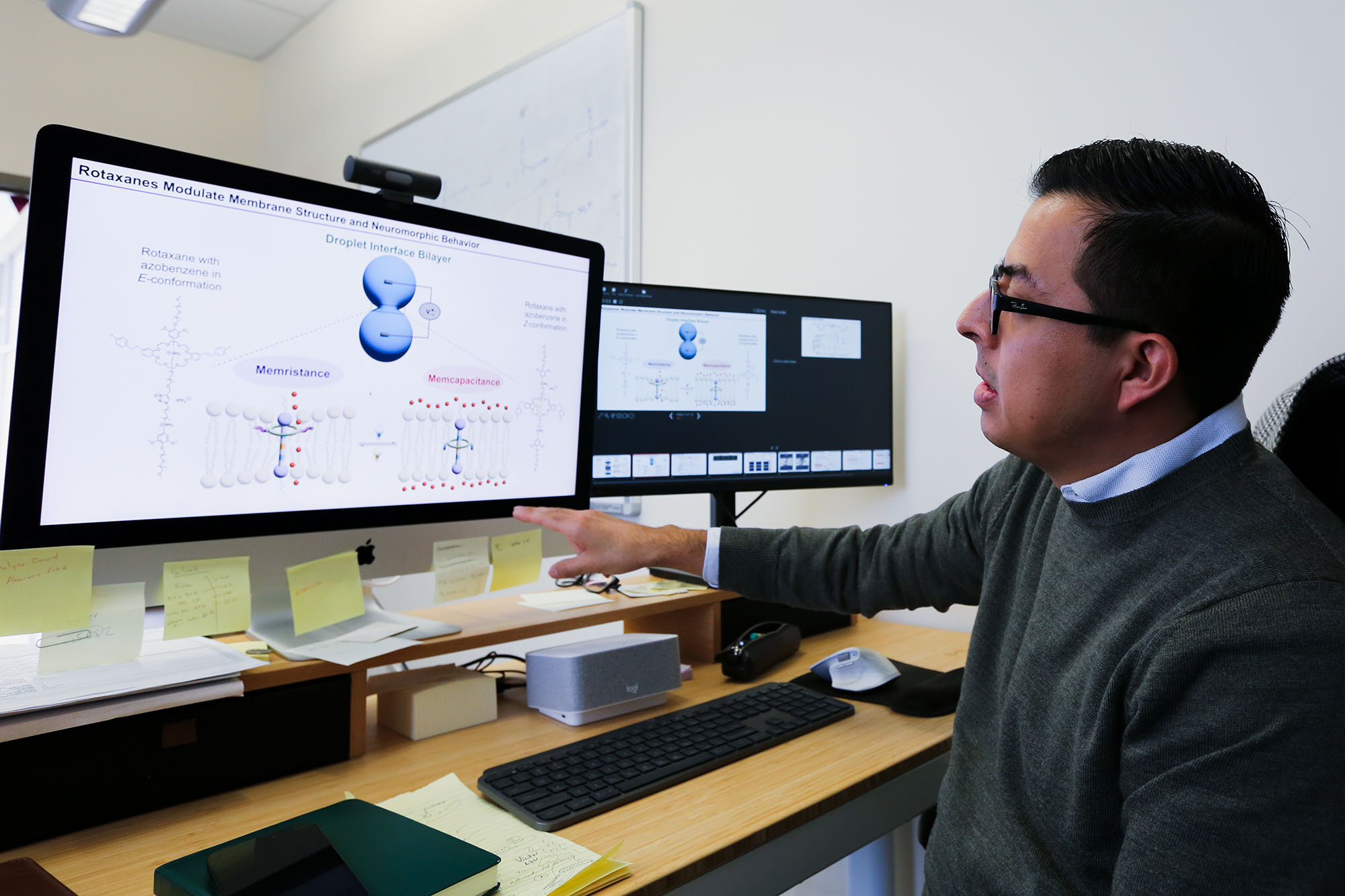
Víctor García-López, assistant professor in the Department of Chemistry in the LSU College of Science, speaks about his research.
In the brain, learning and processing are integrated
“In the brain, processing and memory reside in the same system, in the same hardware. Data doesn’t have to flow between two different places for learning to happen,” said Víctor García-López, an assistant professor in the Department of Chemistry in the LSU College of Science. García-López explains that learning and memory are built into how neurons communicate with each other.
Neurons talk to one another through electrical “signals” that travel along neurons and between them, across gaps called synapses. Each electrical wave triggers the opening of ion channels—proteins located within the lipid membranes that form the “walls” of each neuron.
When an electrical wave arrives at a synapse, ion channels open and calcium ions flow in. These ions activate proteins that trigger neurotransmitters to exit the neuron’s walls and travel to neighboring neurons, passing on the electrical signal.
Here’s the cool part: The more often a signal travels along a particular neuronal pathway, the stronger the connection between those neurons becomes. Repeated activity leads to a buildup of proteins that trigger neurotransmitter release, making signals easier to send and more effective at activating the next cell.
This is how learning happens, built directly into the way signals move through the brain.
“That's why they say, if you want to learn something, you have to repeat it,” García-López said. “You are training your synapses, but at the very molecular level, the repeated activity of ions crossing across the neuronal membrane is triggering stronger signals.
“The question is, can we develop computers that work more like the human brain and model how neurons communicate?”
Many experts are pursuing this very idea in the field of neuromorphic computing. But how do you create artificial neuronal pathways that can “learn” based on repetition and reinforcement?
This requires devices known as memristors (which allow current to flow) and memcapacitors (which store charge) that can ‘remember’ past signals while actively processing new ones, bringing computers a step closer to how the brain works.
The problem is that most experts are still trying to create these devices with solid-state materials.
“If we want to mimic the brain, why don’t we use materials that are in the brain?” García-López said.
The key to neuromorphic computing might be a lipid membrane… and a light-controlled molecular switch
García-López has been working with Dr. Charles Collier and Dr. John Katsaras at Oak Ridge National Laboratory to design soft materials built from biological components, such as lipids, that can “remember” past electrical activity. These materials exhibit memory-like electrical behaviors.
In their newly published study, the researchers describe the creation of bioinspired materials that can be engineered to perform neuromorphic functions, which could be implemented in the future for sensing and brain-like computation.
Resistors and capacitors are among the most fundamental components of electrical circuits. Memristors and memcapacitors are devices whose resistance or capacitance depends on past input. They can store their states even when the power is off. They can enable a new type of computing in which memory and processing are combined.
Over the past few years, researchers at Oak Ridge have created double lipid layers, or “bilayers,” that resemble the “walls” around neurons. They’ve shown that one type of lipid bilayer can act as a memcapacitor, allowing ions to accumulate on either side, and another type as a memristor, allowing ions to flow through ion channels.
García-López was giving a talk at Oak Ridge when he met Charles Collier. García-López had a chemical tool from his lab’s previous research at LSU that could switch a lipid bilayer between permeable and non-permeable states.
As they talked, it quickly became clear that combining this molecule with lipid bilayers at Oak Ridge could open exciting new possibilities for a soft material that could switch between resistive and capacitive states.
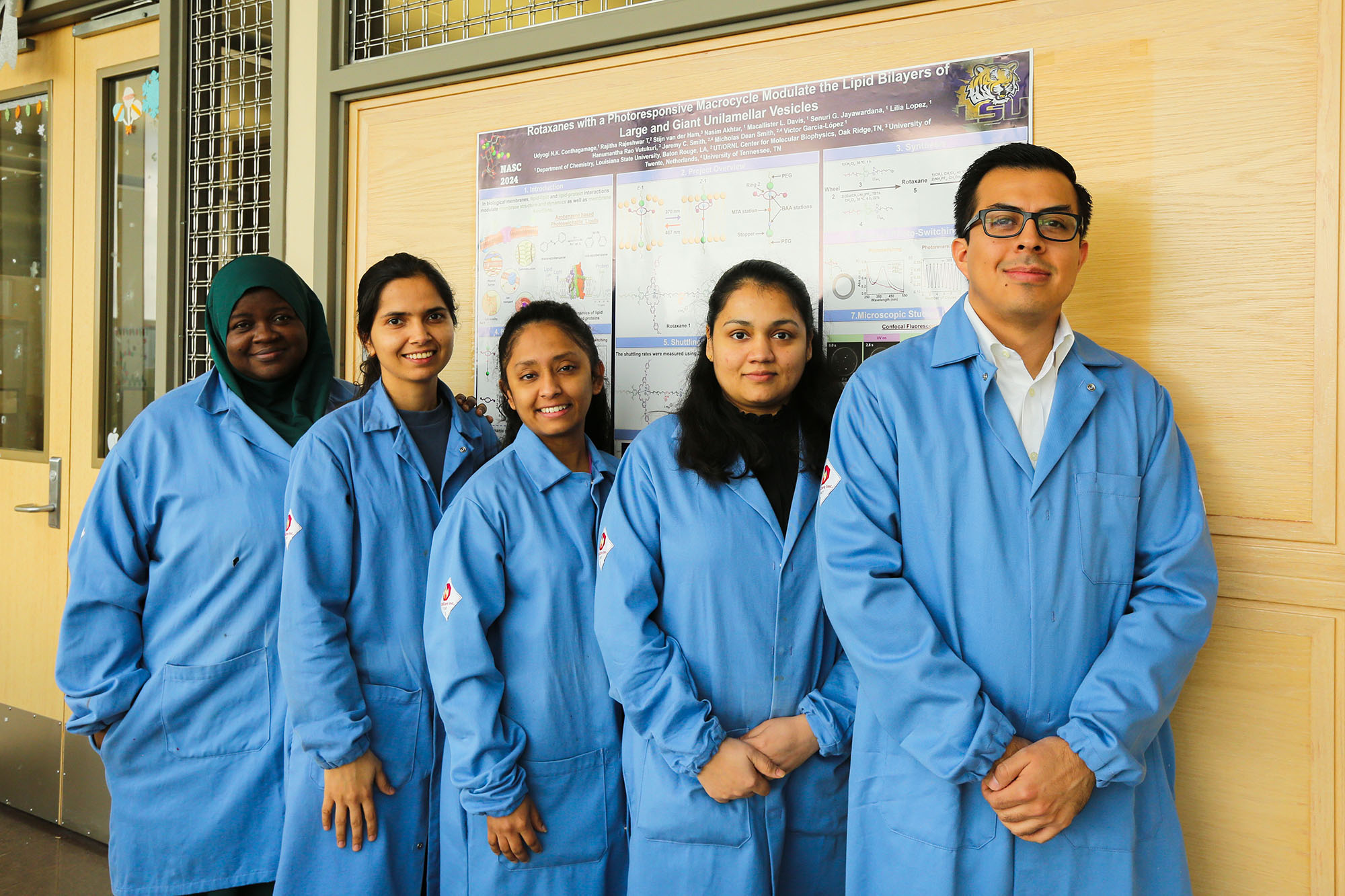
Víctor García-López, right, with members of his lab team.
García-López’s lab has created a unique molecule, somewhat like a tiny molecular machine, that changes its configuration in response to light. The molecular machine is called a rotaxane and has a ring-on-a-rod structure, in which a cyclic molecule is threaded onto an axle. When exposed to different wavelengths of light, the ring component changes shape.
“My group conceived and developed this new class of molecules designed to modulate lipid membrane structure. We synthesized these compounds and spent a couple of years systematically investigating how they interact with and reshape lipid bilayers in vesicular systems,” García-López said.
The rotaxane can exist in two states. In one state, when embedded in a lipid membrane, the rotaxane alters membrane packing, creating holes that allow ions to pass through. When exposed to voltage, the membrane behaves as a memristor, a resistor with memory.
But when exposed to a particular wavelength of light, the rotaxanes change shape, inducing tight lipid packing and preventing ions from crossing the bilayer. Charges accumulate, and the system behaves as a memcapacitor.
“The same membrane can be switched between these two neuromorphic behaviors simply by illuminating it with light, enabling dynamic control over the device function,” García-López said.
“We can reversibly go between two different electrical behaviors without having two different systems.”
Seeing the switchable behavior of these membranes is quite remarkable. In one video, García-López demonstrates a vesicle—a circular enclosed structure with rotaxanes embedded in the lipid membrane—that shrinks or expands when light is shone on it.
In the newly published paper, the researchers demonstrated changes in electrical current across a switchable rotaxane-studded membrane.
Biological membranes containing rotaxanes have many applications, thanks to the ability to control their thickness and permeability. But the ability to create soft resistor-capacitor devices is quite novel.
“We are really the first ones to create an artificial or molecular switch for soft neuromorphic devices,” García-López said. “This doesn’t solve all the issues needed to make soft material neuromorphic computing possible, but it is an important step.”
A switchable memristor-memcapacitor can save materials, space, and energy while improving performance and precision in an electrical circuit. Biomimetic membranes that can switch between memristor and memcapacitor modes open up many new opportunities in neuromorphic computing, reducing the complexity of the required architecture.
“Our Oak Ridge collaborators are really pioneers in creating membrane-based neuromorphic materials, but in most cases, separate membranes are needed, or different voltage conditions for each functional state,” García-López said.
“By integrating our light-responsive molecules with their platform, we can use light to reversibly switch between neuromorphic states in a single membrane.”
This research was made possible through a collaboration with scientists at Oak Ridge National Laboratory and partial support from the LSU Provost Big Idea Grant.
Read the study: Photoresponsive Rotaxanes Switch Lipid Bilayer Neuromorphic Behavior with Light